
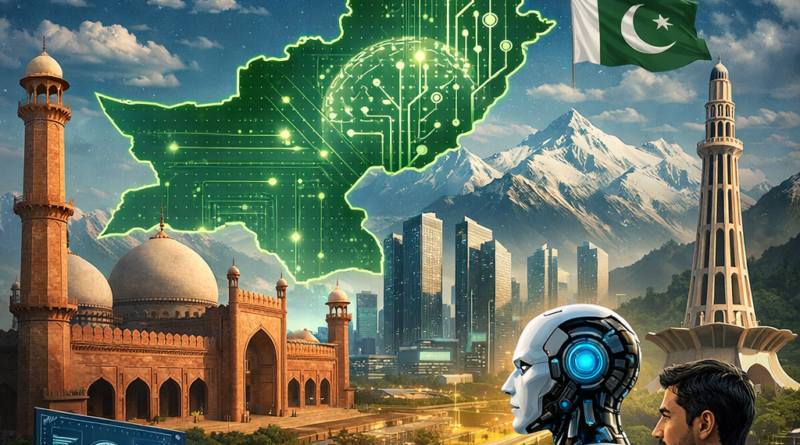
How AI Will Impact Pakistan in the Next 5 Years: A Complete and Honest Look
Pakistan stands at a remarkable crossroads. With a population of over 240 million people, a median age below 23, and one of the fastest growing freelance economies in the world, the country is quietly positioning itself to absorb and benefit from the artificial intelligence revolution in ways that most global analysts have not yet fully appreciated. The next five years will not simply bring change. They will bring transformation at a scale this generation has never witnessed.
The Economy Will Never Look the Same
Pakistan’s economy has long wrestled with inflation, debt cycles, and a heavy dependence on remittances. AI is about to rewrite that story. Across banking, agriculture, retail, and manufacturing, intelligent systems are already beginning to automate tasks that once required entire departments. Faysal Bank, HBL, and several fintech startups have quietly begun integrating AI driven fraud detection and credit scoring tools that allow them to serve customers who previously had no access to formal financial services.
The freelance sector deserves special attention here. Pakistan ranks among the top five countries in the world for freelance earnings, and AI tools are dramatically multiplying what individual Pakistani freelancers can produce. A graphic designer in Lahore who once delivered three projects a week can now deliver fifteen with the help of AI image tools. A content writer in Karachi who charged modest rates can now offer multilingual content at scale. This productivity explosion will push Pakistan’s freelance export earnings significantly higher, possibly doubling them within the next few years if proper digital infrastructure follows.
Agriculture Gets a Brain
Over 37 percent of Pakistan’s workforce is tied to agriculture, and this sector has historically suffered from two crippling problems: unpredictable weather and outdated farming practices. AI is arriving with answers to both.
Precision agriculture platforms powered by satellite imaging and machine learning are beginning to give Pakistani farmers something revolutionary: the ability to know exactly when to plant, when to irrigate, how much fertilizer to apply, and when a pest outbreak is approaching before it becomes visible to the naked eye. Startups like Ricult have already demonstrated what AI enabled advisory services can do for smallholder farmers in Punjab and Sindh. Crop yield improvements of 20 to 30 percent are not a distant dream. They are a documented reality in early pilot programs.
Within five years, AI powered weather forecasting tools calibrated specifically for Pakistan’s diverse microclimates, from the arid plains of Balochistan to the fertile river valleys of KPK, will become as common among farmers as mobile phones are today. The country that has often struggled to feed itself consistently will find new stability in this transformation.
Education: Closing the Gap or Widening It
Pakistan’s education system faces enormous pressure. Millions of children remain out of school, and those inside classrooms often receive instruction of inconsistent quality. AI presents a dual edged opportunity here, and it is important to be honest about both sides.
On the positive front, AI tutoring platforms are making personalized education accessible in ways the traditional system never could. A student in rural Khyber Pakhtunkhwa with a smartphone and internet access can now receive math tutoring, Urdu comprehension practice, and even English language coaching through intelligent apps that adapt to their individual learning pace. Platforms offering Urdu language AI interfaces are expanding rapidly, which matters enormously in a country where millions are not comfortable engaging with technology in English.
The challenge, however, is real. If AI powered education floods urban centers while rural areas remain disconnected due to electricity shortages and lack of internet access, the existing inequality in Pakistan’s education system will deepen rather than heal. The next five years will be a test of whether government policy and private investment can ensure that AI’s educational benefits reach every province and every income level.
Healthcare Reaches Where Doctors Cannot
Pakistan has a severe shortage of doctors relative to its population, particularly in smaller cities and rural areas. AI is beginning to fill this gap in quiet but consequential ways.
AI diagnostic tools that analyze medical images for signs of tuberculosis, diabetic retinopathy, and cervical cancer are already being piloted by organizations working in Pakistan’s underserved communities. These tools do not replace doctors. They extend the reach of medical expertise to places where no doctor may arrive for weeks. A trained health worker in a remote village equipped with an AI diagnostic app can now perform preliminary assessments that would previously have required a journey to a distant city hospital.
Telemedicine platforms enhanced by AI are also changing the doctor patient experience in Pakistan’s urban areas. Appointment scheduling, symptom checking, prescription reminders, and health monitoring through wearable devices are becoming part of everyday life for Pakistan’s growing urban middle class. Within five years, AI driven healthcare tools will likely reduce preventable deaths in Pakistan more meaningfully than any single government health program has managed in the past decade.
The Job Market: Fear Less, Prepare More
No conversation about AI in Pakistan would be complete without addressing the question that keeps many people awake at night. Will AI take our jobs? The honest answer is: some, yes. But the fuller answer is far more interesting.
Pakistan’s young workforce, when properly equipped, has a structural advantage over older workforces in developed countries. Young people adapt faster. They have fewer habits to unlearn. A 20 year old in Islamabad who begins learning prompt engineering, AI model training, data annotation, and automation workflow design today will be extraordinarily employable by 2030, both domestically and in the global remote job market.
The jobs AI will eliminate in Pakistan are largely those involving repetitive data entry, basic customer service scripts, and routine document processing. The jobs it will create involve AI system management, digital content strategy, AI ethics oversight, and the kind of creative human judgment that no model can replicate. Pakistan’s universities and vocational training institutes must pivot now, and several are already doing so, introducing AI literacy programs and partnering with international platforms to prepare students for this new reality.
Government, Policy, and the Regulation Question
One of the most consequential factors in determining how AI impacts Pakistan over the next five years will be government policy. Pakistan has made early moves in the right direction. The National AI Policy framework has been discussed at the federal level, and the Ministry of Information Technology has acknowledged the urgency of establishing a regulatory environment that attracts AI investment without stifling innovation.
The risk is that regulation either arrives too late, allowing unchecked AI use to cause social harm, or arrives too heavy handed, pushing investment and talent toward neighboring countries. India, the UAE, and Saudi Arabia are aggressively courting AI companies and talent. Pakistan must compete intelligently, offering tax incentives for AI startups, creating regulatory sandboxes for experimentation, and protecting citizens from AI driven misinformation and surveillance.
Cybersecurity will become a national priority within this period. As AI tools become more sophisticated, so do the threats they enable. Deepfake technology, AI generated misinformation campaigns, and automated phishing attacks are already emerging challenges in Pakistan’s digital landscape. A robust national cybersecurity strategy enhanced by AI defense tools will not be optional. It will be essential.
The Cultural and Social Dimension
AI does not arrive in a vacuum. It lands inside a culture, and Pakistan’s culture will shape how AI is received, resisted, and ultimately adopted.
Urdu language AI tools, voice interfaces, and regionally localized applications will determine whether AI becomes truly accessible to Pakistan’s masses or remains a privilege of the English speaking urban elite. The good news is that large language models are rapidly improving their Urdu and regional language capabilities. Companies and researchers who build Pakistan specific AI applications, understanding local idioms, religious sensitivities, and regional diversity, will find an enormous and largely untapped market waiting for them.
There is also a deeper social question about trust. Pakistanis, like people everywhere, will need to trust the systems that increasingly influence their financial decisions, medical diagnoses, and educational pathways. Building that trust requires transparency, accountability, and visible benefit. When a farmer in Rahim Yar Khan sees his crop yield increase because of an AI recommendation, trust follows naturally. When a first generation university student in Quetta passes an exam with the help of an AI tutor, the technology earns its place in that community.
Looking Ahead With Clear Eyes
The next five years will not be a smooth, linear march toward an AI utopia in Pakistan. There will be disruption, inequality, resistance, and genuine hardship for workers whose skills become obsolete faster than they anticipated. These realities must be acknowledged honestly rather than papered over with optimism.
But the broader trajectory is one of genuine opportunity. Pakistan has everything required to benefit enormously from the AI revolution: a massive young population hungry for economic mobility, a proven freelance talent base already comfortable with digital tools, an agricultural sector desperately in need of modernization, and a diaspora with deep connections to global technology ecosystems.
The countries that will benefit most from AI are not necessarily the ones with the most advanced technology today. They are the ones with the most adaptable people, the most urgent problems that AI can solve, and the collective will to embrace change without losing their identity in the process. Pakistan has all three. The next five years will prove it.