The $60 Billion Story: How Cursor Went From a Dorm Room Idea to Elon Musk’s Biggest Bet — And Why a Kid From Karachi Is at the Center of It All
Introduction: The Deal That Shook Silicon Valley
On April 21, 2026, a single post on X stopped the tech world in its tracks. SpaceX – yes, the rocket company – had just announced a jaw-dropping deal with an AI startup called Cursor: the right to acquire the company for $60 billion by the end of the year. If SpaceX decides to walk away from the acquisition, it still owes Cursor $10 billion for the work done together. Either way, Cursor wins. Big.
The deal is part of SpaceX CEO Elon Musk’s broader plan to transform the rocket company into an AI powerhouse ahead of its anticipated IPO. But beyond the staggering dollar figures, this story is about four young people who met in college, dropped out, and built something the world didn’t know it needed. One of them – quietly, brilliantly – grew up riding a motorcycle through the streets of Karachi.
This is the full story of Cursor: what it is, how it was built, who built it, and why this moment may define the next decade of software development.
What Exactly Is Cursor?
Before we dive into the drama and the billions, let’s make sure you understand what Cursor actually does — because without that context, none of the rest makes sense.
Cursor is a coding assistant with its own integrated development environment, or IDE, where the company’s AI is built directly in. Think of it as Microsoft Word, but for writing software code – except this version actively thinks alongside you, anticipates what you’re about to type, catches your mistakes before you make them, and can even write entire blocks of code based on a simple description you give it in plain English.
Built on a fork of Visual Studio Code – the world’s most popular code editor – Cursor combines repo-wide code understanding, multi-file editing agents, and native terminal access in a single interface. Instead of reinventing the wheel, the founders took the tool millions of developers already used and made it dramatically smarter.
At its most basic level, when a developer writes code in Cursor, the AI is watching – not in a creepy way, but in the way a brilliant pair-programmer would. It understands not just the lines you’re writing, but the structure of your entire project, the history of your commits, and even past bugs you’ve fixed. Cursor’s competitive advantage lies in this deep codebase awareness, mapping not just current code but structure, commit history, and past debugging sessions.
The result? Developers write code faster, make fewer errors, and can tackle more ambitious projects with smaller teams. It’s no exaggeration to say Cursor has changed how software is made.
The Company Behind Cursor: Anysphere
Cursor is made by Anysphere, Inc., an American software company founded in 2022 and based in San Francisco. The name “Anysphere” may not ring a bell for most people, but Cursor – its sole product – has become a household name among developers worldwide.
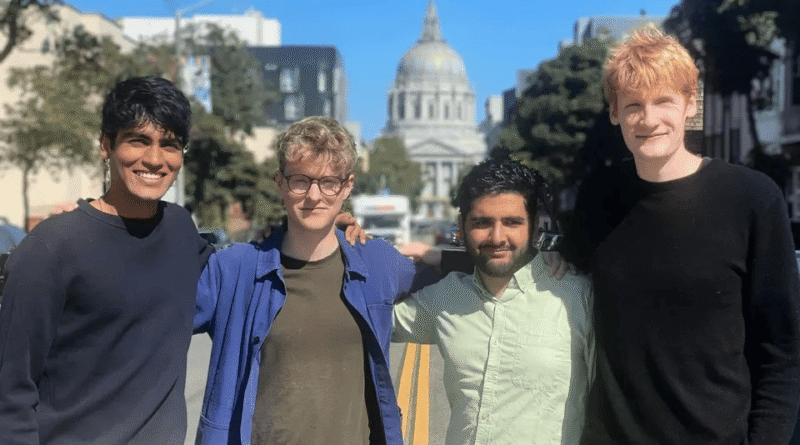
The company was incorporated in 2022 by four MIT classmates: Michael Truell, Sualeh Asif, Arvid Lunnemark, and Aman Sanger, who met while studying computer science and mathematics. They weren’t venture capitalists or tech veterans. They were students – young, ambitious, and frustrated with the tools they were forced to use every day.
The Founders: Four Friends, One Vision
Michael Truell – The CEO Who Started Coding at 11
Michael Truell grew up in New York City and attended the Horace Mann School, a private prep school in the Bronx. He’d always had an interest in technology and started coding at age 11 to make his own mobile games.
By the time he reached college, Truell had already interned at Google and Two Sigma – two of the most prestigious names in tech and finance. He was a USA Computing Olympiad finalist, meaning he competed at the national level in competitive programming. His technical skills were not in question. What drove him wasn’t just the ability to code – it was the burning desire to make coding itself better for everyone.
At just 25, this former Google intern turned a college passion project into one of the most valuable AI companies on the planet. Truell is now worth an estimated $1.3 billion, according to Forbes.
Sualeh Asif – Pakistan’s Billion-Dollar Son
If there is one name from this story that every Pakistani should know, it is Sualeh Asif. His journey is the kind that movies are made about.
Sualeh Asif comes from Karachi, where he studied at Nixor College. He was not born into extraordinary privilege. He was a middle-class kid from a busy city, navigating life like millions of others – but with one extraordinary gift: a mind built for mathematics.
His exceptional aptitude for mathematics emerged during high school. He represented Pakistan at international math contests, earning honorable mentions at the 2017 and 2018 Asian Pacific Mathematical Olympiads. He also taught at Pakistani math camps, showing early drive and technical skills.
That combination – raw talent plus a desire to give back – is what makes his story different. He wasn’t just collecting trophies. He was sharing knowledge with the next generation of young Pakistanis even as he was climbing.
His academic journey led him to MIT, where he became part of the prestigious Neo Scholars program – a mentorship network for technical undergraduates – which propelled him into a network of top innovators.
At MIT, he met Michael Truell, Arvid Lunnemark, and Aman Sanger. They didn’t just become friends – they became co-founders. Before starting Anysphere, Asif had already launched an AI-based search engine project during his time at MIT. The entrepreneurial fire was burning long before Cursor existed.
Today, Sualeh Asif is Cursor’s Chief Product Officer. He leads development on core features like the Tab function – a speculative-editing tool that anticipates multi-line code changes, guides the cursor across files, and proposes terminal commands. In simpler terms, he built the feature that feels like magic when you use it.
Umar Saif, the former federal minister for IT, praised Asif as “the kind of role model Pakistani youth needs” – not property dealers, tax evaders, or those born into wealth, but a self-made kid from a middle-class family in Karachi who studied at MIT, started a hugely impactful company, and is now worth over $1 billion at the age of 26.
Arvid Lunnemark – The Olympiad Champion
Arvid Lunnemark won medals at the International Olympiad in Informatics and held roles at Stripe, Jane Street, and QuantCo before co-founding Cursor. His background in competitive programming and elite financial technology firms brought a different kind of rigor to the team.
Aman Sanger – The AI and Enterprise Bridge
Aman Sanger brought experience in medical AI and enterprise machine learning, with roles at Google, Bridgewater Associates, and You.com. While his teammates were deep in competitive programming, Sanger understood how AI worked in real-world, high-stakes business environments – a perspective that would prove invaluable as Cursor scaled to Fortune 500 companies.
From College Project to Billion-Dollar Startup: The Timeline
2022 – The Birth of an Idea
The team raised a $400,000 pre-seed round in April 2022 to start development. Instead of building a new IDE from scratch, they forked Visual Studio Code, allowing them to offer a familiar interface while embedding AI deeply into the development process. Smart, pragmatic, and fast – exactly how great startups move.
2023 – The Launch
Anysphere graduated from OpenAI’s accelerator program in 2023 and launched Cursor in March 2023.
In October 2023, the startup announced an $8 million seed round led by the OpenAI Startup Fund, with angels including former GitHub CEO Nat Friedman and Dropbox co-founder Arash Ferdowsi. Getting backing from the people who literally built GitHub – the platform every developer uses – was a massive vote of confidence.
2024 – Explosive Growth
Subscription revenue reportedly climbed from $4 million in April 2024 to $48 million by year-end. That’s a 12x increase in revenue in under a year. Cursor wasn’t just growing – it was exploding.
A $60 million Series A followed, then a $100 million Series B, pushing the valuation to $2.4 billion.
Cursor hit the $100 million annualized revenue milestone in January 2025 – around one year and eight months after it launched its first product. Slack took two and a half years to hit that same mark. Dropbox took four years. Cursor did it in under two.
2025 – The Unicorn Becomes a Decacorn
The growth in 2025 was almost incomprehensible. The company’s valuation skyrocketed from $2.5 billion to $30 billion in a single year.
Cursor reached a $29.3 billion valuation in November 2025 after raising $2.3 billion in a funding round co-led by VC heavyweights Accel and Coatue.
Its annualized revenue crossed $2 billion in February 2026. The company had gone from zero to $2 billion in annual revenue in less than three years.
As of December 2025, it had over 1 million daily active users, powered 50,000 businesses, and achieved 9,900% year-over-year ARR growth. That is not a typo.
Who Uses Cursor?
Some 67% of Fortune 500 companies use Cursor’s technology. Well-known names include Salesforce, Samsung, and Budweiser.
Millions of developers at 50,000 companies rely on it for coding tasks, including major names like Nvidia, Adobe, Uber, and Shopify.
What started as a tool four college students wanted for themselves became the standard for how professional software gets written.
The AI Behind the Magic: Composer
A key moment in Cursor’s evolution came in late 2025 when the company stopped relying entirely on other companies’ AI models and started building its own.
Cursor released Composer less than six months ago as its first agentic coding model. Composer 1.5 then scaled reinforcement learning by over 20x. Composer 2 added continued pretraining, reaching frontier-level performance at a fraction of the cost of other models.
This mattered enormously. Cursor had always used AI from Anthropic and OpenAI to power its features. But those same companies – Anthropic with Claude Code, OpenAI with Codex – were now building their own coding tools to compete directly with Cursor. Building proprietary models gave Cursor independence and a competitive edge.
But there was a problem: building and training cutting-edge AI models requires enormous amounts of computing power. And that’s exactly what the SpaceX deal solves.
The SpaceX Deal: What Actually Happened
April 21, 2026 – The Announcement
On April 21, 2026, SpaceX announced a unique deal with AI startup Cursor that would give it the option to buy the company for $60 billion later this year.
SpaceX described the partnership as a project combining Cursor’s “product and distribution to expert software engineers” with SpaceX’s Colossus supercomputer, which the company claims has the equivalent compute power of a million Nvidia H100 chips.
Cursor CEO Michael Truell said he’s “excited to partner with the SpaceX team to scale up Composer,” referring to the company’s own AI model.
The Terms of the Deal
The structure of this deal is unlike anything Silicon Valley has seen before. Here’s how it works:
At some point later this year, SpaceX will either pay Cursor $10 billion for its work or acquire the company for $60 billion. Cursor, for its part, has given SpaceX an exclusive window – essentially agreeing not to be acquired by anyone else for now.
Cursor stopped being just an editor in March. They shipped Composer 2, their own model, and it beat Claude Opus 4.6 on Terminal-Bench at one-tenth the price. This is the product that SpaceX is betting on.
Why SpaceX? Why Now?
The timing is not accidental. Musk merged SpaceX with his xAI startup in February in a deal valued at $1.25 trillion, and the combined company is in the process of going public in what’s likely to be a record IPO. The SpaceX IPO, targeted for June, is aiming for a valuation between $1.75 trillion and $1.8 trillion, potentially making it the largest in history.
Adding Cursor – with its massive developer user base and $2 billion in annual revenue – to that story is a powerful move ahead of a public listing.
Cursor had wanted to push its training efforts much further but was bottlenecked by compute. With this partnership, the team will leverage xAI’s Colossus infrastructure to dramatically scale up the intelligence of its models.
Microsoft Almost Got There First
Prior to SpaceX’s announcement, Microsoft had looked at a potential deal for Cursor but chose not to proceed with a bid. That decision may go down as one of the most expensive missed opportunities in tech history.
xAI Staff Movements Signal Deeper Ties
Two of Cursor’s most senior engineering leaders, Andrew Milich and Jason Ginsberg, left the company to join xAI, where both now report directly to Musk. These personnel moves happened in the weeks before the official announcement – a signal that the partnership had been brewing beneath the surface for some time.
What This Means for the AI Coding Wars
The AI coding market is now a full-scale battle between some of the biggest names in tech. Anthropic has Claude Code. OpenAI has Codex. Google has Gemini-powered tools. And now SpaceX-xAI has Cursor.
One industry analyst described the SpaceX-Cursor arrangement as consolidating a vertically and horizontally integrated AI development stack: Colossus compute underneath, xAI foundation models in the middle, and Cursor’s coding product covering the developer workflow above – matching patterns already visible with OpenAI/Microsoft, Google, and Anthropic/AWS.
The era of standalone coding tools is ending. The future belongs to integrated stacks where the same company controls the chips, the models, and the user-facing product. Cursor, with SpaceX behind it, is now positioned to compete in that league.
What This Means for Pakistan
Sualeh Asif’s story is more than an individual success. It is a mirror held up to Pakistan’s potential.
A young man from Karachi – not from an elite family, not born into connections or capital – competed in international mathematics olympiads, won a spot at MIT, built a startup in his dorm room, and is now a billionaire at 26. His company is at the center of one of the most significant deals in the history of artificial intelligence.
His achievements shine a light on a much deeper issue – the consistent loss of brilliant Pakistani minds to more supportive environments abroad. His success story reveals the immense potential within Pakistan’s streets and classrooms, yet also reminds us of the systemic challenges that force talent to seek growth elsewhere.
Sualeh didn’t leave Pakistan because he lacked ambition for his homeland. He left because the infrastructure to support someone like him didn’t exist at home. The question Pakistan must sit with is: how many more Sualeh Asifs are navigating Karachi’s streets on motorcycles right now, with no path to MIT and no access to the networks that change lives?
What’s Next for Cursor?
Cursor is in talks to raise a $2 billion fundraising round at a valuation of over $50 billion, with Andreessen Horowitz slated to co-lead the new investment round and Nvidia also expected to participate.
The SpaceX deal has given Cursor something no other independent AI coding company has: guaranteed compute at a scale that rivals the biggest AI labs in the world, plus $10 billion in downside protection, and a potential $60 billion exit.
Whether SpaceX ultimately acquires Cursor or the two companies part ways after a year of collaboration, Cursor has already won. It has compute. It has revenue. It has the world’s best developers using it every day. And it has a founding team that has proven, at every stage, that they are capable of outpacing giants.
Conclusion: A New Chapter for AI – and for Coding Itself
The story of Cursor is the story of what happens when a small group of deeply talented people identify a problem, build the right solution, and refuse to stop improving it. It is a story about timing – catching the AI wave at exactly the right moment. It is a story about courage – four students dropping out to bet on themselves. And it is a story about global talent – because one of the most important companies in the world right now has a co-founder who learned mathematics in Karachi, taught kids at local math camps, and then went and changed how software is written.
With the launch of Cursor 3 earlier this month, the company has improved on its agentic coding, in which AI can write code on its own with broad user guidance. The product keeps getting better. The stakes keep getting higher.
Whether the final chapter is a $60 billion acquisition or something even more dramatic, one thing is certain: Cursor has already changed the world. And Sualeh Asif – from Karachi, via MIT, to the heart of Silicon Valley – helped build every pixel of it.